.svg)
.jpg)
January 20, 2026
LGR continues to be a dominant theme across much of the local government landscape. Naturally for those involved, there is much uncertainty over the future shape of their organisations and their future roles in the new world. A lot of the thinking has been focusing on the opportunities and constraints of reorganization – from an inside out perspective.
Apart from some general headline messaging regarding the future benefits of LGR for citizens, there seems to be far less focus and discussion on how we optimise their experience - both during and after the considerable change involved.
The key word here is change.
LGR is all about change – moving from a current to a future state – and beyond (i.e. perpetual, continuous).
Question - How will we measure this change? What are the key variables we should measure?
Answer - The change in citizen experience vs the change in costs.
The costs bit (which for most organisations is the main driver) is the most knowable – a hundred years of accounting and budgeting practices provides consistent method of how to do this.
But what about measuring the citizen experience? In this area we are far less equipped. There are few common methods for doing this across public services in the UK.
What’s more – the 2 variables (cost and citizen experience) are interdependent – as well as being measured independently, change in one will impact the other. They need to be read together.
How do we, therefore, measure citizen experience in a consistent way that adds continuous value to understanding progress of our change programmes?
Over the last 20 years GovMetric has been evolving it’s thinking and services alongside the changing UK government landscape. We’ve been through all the same challenges and initiatives – and bear the same scars and insights as a result.
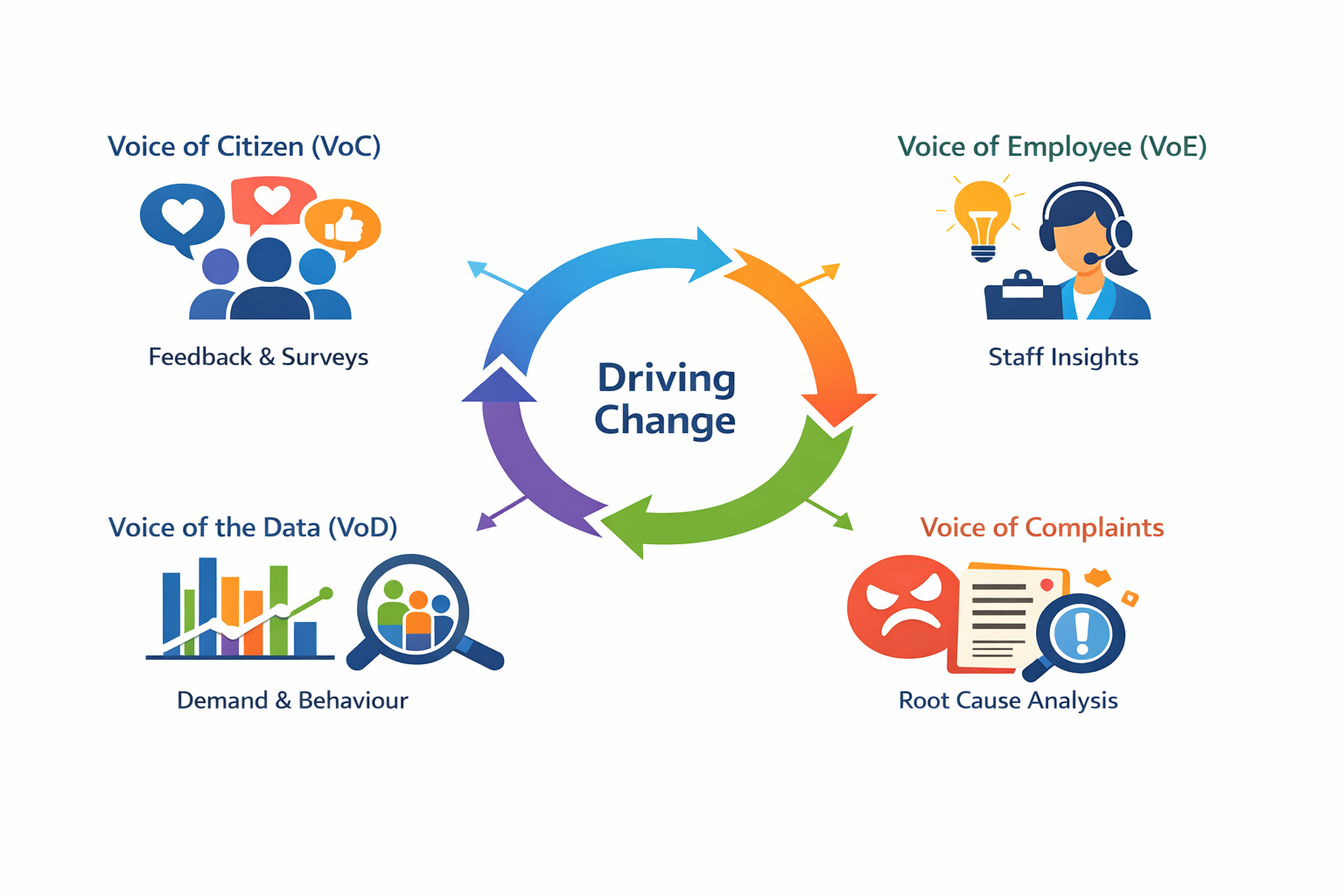
• Voice of Citizen (VoC) – what do citizens say about services – via feedback, surveys, consultations, social media, forums etc.
• Voice of Employee (VoE) – employee insights on why things go wrong (or right) – frontline insights continuously feeding into change. (not to be confused with eNPS)
• Voice of the Data (VoD) – understanding demand and behaviour - see John Seddon and Jens Gemmel for great approaches to enabling consistent demand measurement.
• Voice of Complaints – going upstream from the complaints process to identify the root causes.
Historically most organisations start this process with VoC – but too often it is not integrated, comprehensive, consistent or continuous. And therefore, lacks value in terms of being a reliable measure of progress.
Voice of Citizen (VoC) is of course only part of the solution. We would like to see more organisations systemically and systematically harvesting employee insights (VoE) around the same interactions that we ask citizens about.
And we would also like to see a more consistent approach to demand measurement - eventually progressing to observational / behavioural (VoD).
If you’re struggling with data in those areas – then go to the Voice of Complaints – and start to systematically understand the root causes of complaints and see if you can start to reduce demand in this area.
If we can build replicable method around these data, then one day we will be able to reliably measure and answer the question – how citizen experience improved versus the change in costs.
If you don’t know the answer to this question, then how and where do you invest?
PS – next month we will continue this discussion into developing a systemic ‘feedback framework’ – ensuring you are optimising feedback across your statutory, regulatory and discretionary activities to build a receptive system to optimise change and evolution.
January 20, 2026
December 17, 2025



.svg)
Insights + AI = ROI